In Malaysia, underground mining has cost the power grid billions in losses.
Date: 2025-12-04 Author: Oliver Abernathy Categories: IN WORLD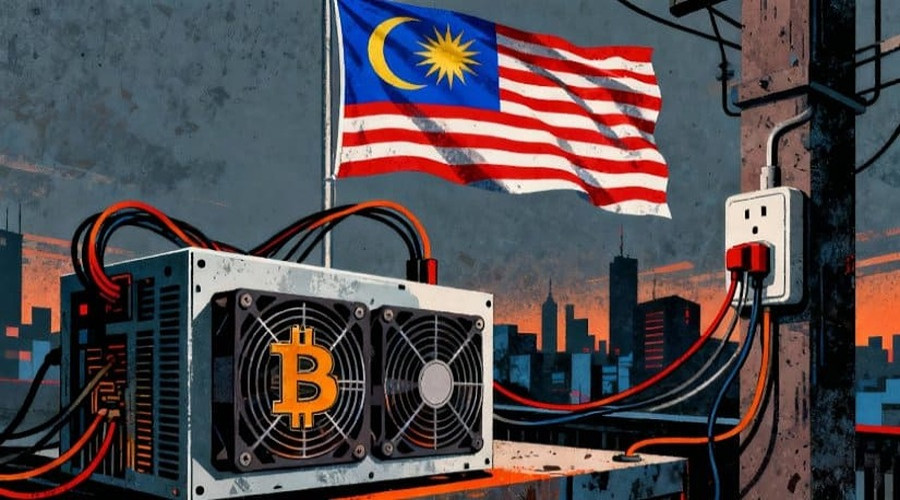
Malaysian authorities have stepped up their crackdown on illegal Bitcoin miners after revelations that underground activity has caused colossal losses to the national power infrastructure over the past five years. According to data published with reference to government agencies, the power company Tenaga Nasional has suffered losses of over $1.1 billion due to widespread electricity theft.
The country's Ministry of Energy reported that approximately 14,000 illegal mining facilities were identified during this period. Most of these operated without official grid connections and without paying taxes, creating additional strain on the power grid and increasing the risk of power outages.
Law enforcement agencies are using modern technology to detect underground farms. Drones, thermal imaging cameras, and portable devices recording abnormal electricity consumption are being used. Local residents, who report suspicious buildings with constant noise and increased network loads, are also playing a significant role. In some cases, criminals have attempted to mask the sound of their equipment, including audio systems playing "birdsong."
Illegal miners operate cautiously and try not to stay in one place for long. They constantly move between empty retail spaces, abandoned houses, and old industrial facilities. Insulation panels, video surveillance systems, and other security measures are used to protect their installations. Authorities believe this level of organization indicates the presence of a well-organized scheme.
By the fall of 2025, amid rising and highly volatile Bitcoin prices, authorities recorded a sharp surge in new violations—by the beginning of October alone, approximately 3,000 new cases of mining-related electricity theft had been identified.
To coordinate the actions of various agencies, the Malaysian government established a special inter-ministerial committee in November. It included representatives from the Ministry of Finance, the central bank, Bank Negara Malaysia, and Tenaga Nasional. The committee's chair, Deputy Minister of Energy Transition Akmal Nasrullah Mohd Nasir, emphasized that the risks have long gone beyond simple electricity theft. According to him, illegal mining threatens the stability of the entire energy system and can lead to damage to key infrastructure.
Mining is formally permitted in the country, but only with official connections to the power grid and compliance with tax laws. However, officials openly doubt that most operators actually comply with these conditions, given the instability of the crypto market and high costs.
Authorities also do not rule out the possibility that a significant portion of illegal mining operations may be controlled by organized crime groups. This is evidenced by their mobility, coordination, and ability to quickly relocate.
Among the most high-profile incidents of recent years were the discovery of a large mining facility in the abandoned ElementX Mall, which was never rebuilt after the pandemic, and a farm on the grounds of a former logging yard in Sarawak. In 2024, police arrested seven people involved in electricity theft and destroyed nearly a thousand mining rigs. In 2025, Tenaga Nasional reported a 300% increase in such crimes compared to 2018.